Three months in. You’re showing up consistently, eating reasonably well, sleeping okay. But something’s off — the weights feel the same as they did in January. You look basically the same too.
This isn’t a motivation problem or a diet problem. You’re probably not progressively overloading.
What it actually means
Your body adapts to stress. That’s literally what getting stronger is — your muscles and nervous system responding to a demand they haven’t fully handled before. Once they’ve adapted, that same demand produces nothing. You need a new, slightly harder demand.
Progressive overload is just the practice of giving your body that new demand on a regular schedule. A bit more weight. A bit more reps. One more set. That’s it.
The reason most people don’t do it isn’t that they don’t understand it. It’s that they don’t track their workouts, so they have no idea what they did last week, so there’s no “more” to aim for.
Three ways to overload
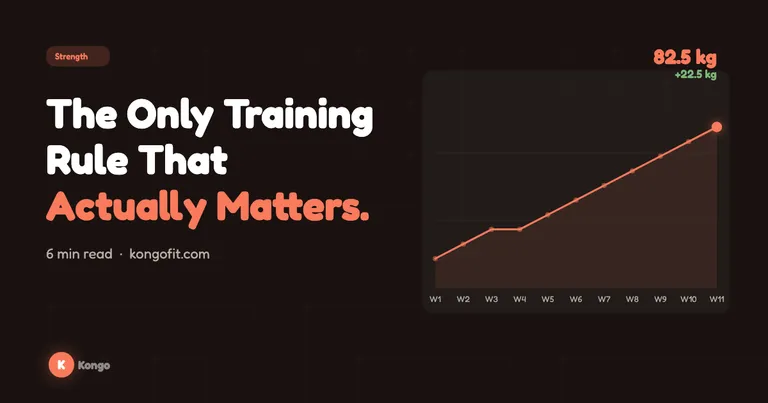
Add weight. The most straightforward. If you benched 60kg for 3 sets of 8 last week, try 62.5kg this week. Even 2.5kg adds up fast — that’s 30kg of extra total load across a session.
Add reps. If you’re not ready to add weight, add a rep. 3×8 becomes 3×9, then 3×10, then you add weight and drop back to 3×8. This “double progression” model is especially beginner-friendly and underused.
Add sets. Going from 3 sets to 4 on your key lifts increases volume without touching the load. Not every session — but over months, it’s real overload.
You don’t need all three at once. Pick one variable, move it forward, log it.
How fast to progress
Beginners can usually add weight every single session. New lifters see rapid neuromuscular adaptation — your brain is learning to recruit more muscle fibers before the muscle itself has grown much. That’s why strength goes up fast at first even when you don’t look different yet.
A rough guide for when to add weight after completing all your target sets and reps:
| Movement | Add |
|---|---|
| Squat / Deadlift | 2.5–5 kg |
| Bench Press / Overhead Press | 1.25–2.5 kg |
| Isolation work | 1.25–2.5 kg, or add reps first |
After 6 months or so, weekly progression becomes the expectation rather than session-to-session. That’s normal — the early gains are partly low-hanging fruit.
The stall is comfortable, which makes it dangerous
When you stop progressively overloading, you don’t feel it immediately. You’re still showing up. You’re still sweating. The workout feels like work.
But nothing changes. You’ve entered what I’d call a “comfortable plateau” — consistent, disciplined, and completely stagnant. These are worse than obvious plateaus because they don’t feel like failure.
The fix is boring: before every session, check what you lifted last time. Do slightly more. Log it.

In Kongo
Kongo loads your previous session’s weights automatically and flags when you’re ready to add load — you don’t have to do the mental math mid-warmup.
That’s the whole system. No periodization schemes, no complicated programming. Just: know what you did, do slightly more, write it down.
Track your progressive overload automatically — download Kongo free on iOS.

Ready to put this into practice?
Kongo is launching soon on iOS — join the waitlist and be first in.






 Free to download
  No spam, ever
  iOS first