You’re at the gym, mid-set, and you’ve hit a wall. The bar feels heavy, your legs don’t want to cooperate, and you’ve been eating “clean” all week — meaning almost no carbs. You figure it must be sleep, or stress, or just a bad day.
It’s not. It’s probably your diet. And here’s the part that’ll annoy you: carbs could’ve prevented the whole thing.
The myth
Carbohydrates make you fat. Cut them out and you’ll lose weight faster, perform better, and feel sharper. Low-carb is the smart move. Keto is even smarter.
This idea has been floating around gyms and diet culture for decades. At this point it’s practically conventional wisdom — which makes it especially frustrating that it’s mostly wrong.
Why it sticks
The logic feels airtight on the surface. Carbs spike insulin. Insulin promotes fat storage. Therefore, fewer carbs means less fat storage. Case closed.
Except it’s not that simple. Insulin also drives nutrients into muscle tissue. The fat-storage effect of insulin is heavily context-dependent — it matters whether you’re in a calorie surplus, not whether you ate a bowl of oats. And when you’re training hard, carbohydrates are doing something entirely different: they’re fueling your muscles at the cellular level in a way that fat just can’t replicate fast enough.
The low-carb narrative also got a huge boost from early-2000s diet books that made it sound like carbs were uniquely fattening. But the mechanism they described was oversimplified, and the actual weight-loss evidence has never backed it up at scale.
What the research actually shows
Start with fat loss, since that’s usually the main reason people go low-carb. In the Stanford DIETFITS trial — 609 participants, one of the most rigorous diet comparisons ever run — a healthy higher-carb diet and a healthy low-carb diet produced nearly identical weight loss over 12 months: 5.3 kg vs 6.0 kg. That 0.7 kg difference wasn’t statistically significant (JAMA — DIETFITS Trial, 2018). When food quality is equal, carb content doesn’t meaningfully change how much fat you lose.
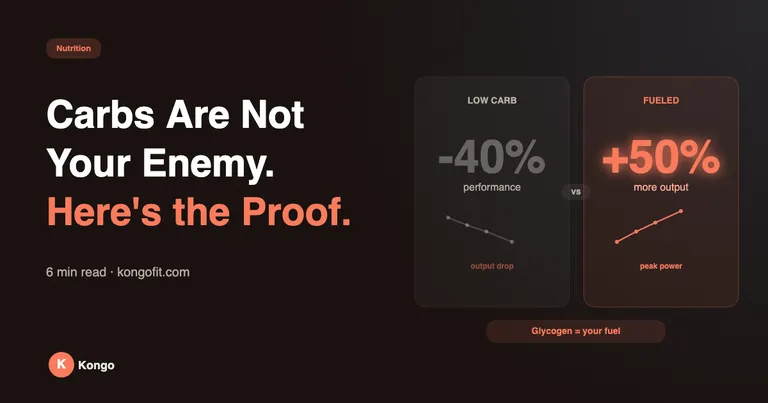
Now look at performance, where the story gets even more lopsided. When muscle glycogen drops to around 100 mmol/kg dry weight, performance at 80% of peak power intensity falls by 20–50% (Nutrients / MDPI, 2025). That’s not a minor dip. That’s potentially cutting your output in half because you’ve chronically underfueled your muscles. No amount of “fat adaptation” fully compensates for that during high-intensity work.
And the evidence on ketogenic diets for athletes? The International Society of Sports Nutrition reviewed 16 controlled trials. One showed performance improvement. Eight showed impaired endurance performance. Seven found no difference (Journal of the International Society of Sports Nutrition, 2024). The most comprehensive sports-nutrition body in the world looked at all the evidence and found that going very low-carb is, at best, neutral for athletic performance — and more often harmful.
There’s one more finding worth knowing about. Researchers tested whether simply rinsing your mouth with a carbohydrate solution — without swallowing any of it — affected exercise performance. Across 35 studies and 76 effect sizes, it produced a small but significant boost in aerobic performance (Journal of the International Society of Sports Nutrition, 2025). Carbs improve output before they’re even digested, by activating receptors in your mouth connected to brain regions that control motor output and motivation. That’s how deeply wired your body is to run on carbohydrates.

In Kongo
Kongo tracks your weights and reps automatically across sessions — so when your performance dips because you’ve underfueled, you’ll see it in your progress charts before you chalk it up to a “bad day.”
What to do instead
You don’t need to eat pasta by the kilo. But you do need to stop treating carbohydrates like a threat.
Match carbs to your training. On days you’re lifting hard, you need carbohydrates — before and after. On rest days, you naturally need less. This is called carb cycling informally, and it’s just common sense applied to fueling.
Focus on quality, not elimination. Whole grains, rice, oats, fruit, potatoes — these are not the problem. Ultra-processed foods high in refined carbs and fat together are the problem. The distinction matters.
Use carb loading strategically. Before a heavy training week or a competition, sustaining a high carbohydrate intake of around 8 g/kg/day for 36–48 hours can effectively double your muscle glycogen levels (Nutrients / MDPI, 2025). You’re not just topping off — you’re supercharging your fuel reserves.
Stop judging your diet by how low-carb it is. Judge it by how you perform, how you recover, and whether your lifts are going up over time. Those are the metrics that actually tell you something.
The people who swear by keto for gym performance are usually doing lower-intensity work, or they’ve unconsciously reduced their training intensity without noticing. At the intensities required to actually build strength and muscle, glycogen is the fuel — and carbohydrates are how you replenish it.
Sources
- Nutrients (MDPI) — Muscle glycogen and its effect on performance at high intensity; carbohydrate supercompensation via loading
- JAMA — DIETFITS Trial — Head-to-head comparison of healthy low-fat vs. healthy low-carb diets in 609 participants over 12 months
- Journal of the International Society of Sports Nutrition (ISSN) — 2024 position stand on ketogenic diets and athletic performance across 16 controlled trials
- Journal of the International Society of Sports Nutrition — 2025 meta-analysis on carbohydrate mouth rinsing and aerobic exercise performance
Track your performance over time with Kongo’s automatic progress charts — and know immediately when your fueling strategy stops working — download Kongo free on iOS.

Ready to put this into practice?
Kongo is launching soon on iOS — join the waitlist and be first in.






 Free to download
  No spam, ever
  iOS first